
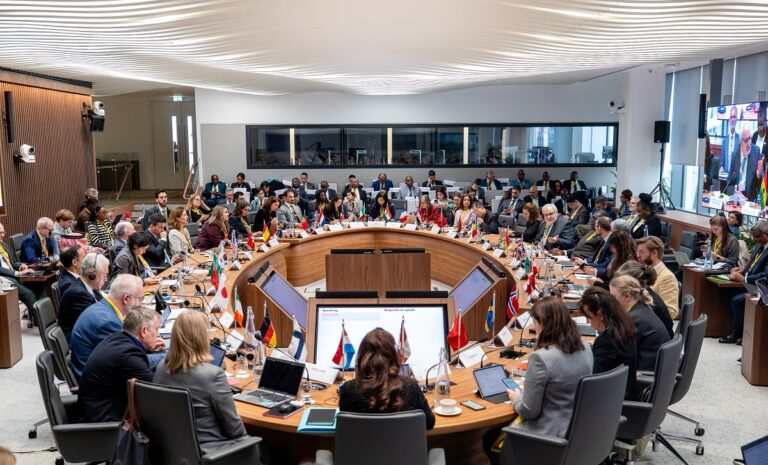
In what development experts have described as a watershed moment for financing in Africa, the African Development Fund mobilizes $11 billion in its 17th replenishment cycle, the largest in the institution’s 53-year history.
The announcement, made at a pledging session in London co-hosted by the United Kingdom and Ghana, represents a 23% increase over the previous funding round and underscores a strategic shift from traditional aid models toward investment-led development and enhanced African ownership.
The African Development Fund (ADF), the concessional lending window of the African Development Bank Group (AfDB), secures this landmark financing from 43 partners, signaling renewed confidence among development partners.
Officials said the outcome reflects growing trust in Africa’s economic potential, even amid constrained global fiscal environments and reductions in foreign aid budgets.
“This is not just a replenishment,” Dr Sidi Ould Tah, President of the African Development Bank Group, told delegates at the session. “It is a turning point.”
His comments, cited in the official press release, laid emphasis on a deliberate transition from traditional aid models to an approach prioritizing investment, risk sharing and scaled financing.
Central to this shift is Africa’s expanding role as a co-investor in its own development. For the first time in the Fund’s history, 23 African countries contributed directly to the replenishment, pledging a combined $182.7 million.
Nineteen of those nations made contributions for the first time, a five-fold increase compared with the previous cycle.
“This is transformational. Africa is no longer only a beneficiary of concessional finance. Africa is a co-investor in its own future,” Dr Ould Tah said, underscoring the symbolic and practical significance of the shift.
The funding round, known as ADF-17, also introduces a novel framework for how concessional resources will be deployed.
Under the newly endorsed model, the African Development Fund will broaden its use of financial instruments to attract private capital and absorb risk.
These include plans to operationalize a Market Borrowing Option and employ hybrid capital structures that blend public and private investment.
The strategy aims to mobilize capital at greater scale, extending the impact of every dollar invested.
According to the Fund’s projections, every dollar invested already unlocks more than $2.50 in co-financing and private capital, a multiplier expected to rise under the new model.
In another first for the Fund, ADF-17 anchors large-scale concessional co-financing partnerships.
Development partners have pledged substantial financing commitments, including up to $800 million from the Arab Bank for Economic Development in Africa (BADEA) and up to $2 billion from the OPEC Fund for International Development.
These partnerships are designed to bring risk-sharing to the fore, enabling the Fund to reach some of Africa’s most challenging environments with catalytic investment.
Development experts say such collaborations may set a precedent for future concessional financing models, which have traditionally relied on bilateral and multilateral grants and low-interest loans alone.
The resources mobilized under the replenishment will be directed to 37 low-income and fragile African countries, with strategic emphasis on key sectors across the continent.
These include expanding access to energy, strengthening food systems and security, investing in human capital, building resilient infrastructure, and advancing regional integration and trade.
Targeted support will also continue for countries facing extreme vulnerability through mechanisms such as the Transition Support Facility, which aims to mitigate risk and maintain development momentum during crisis situations.
The success of this replenishment campaign was framed by Fund leaders and partner officials as a global vote of confidence in Africa’s development trajectory.
Baroness Jenny Chapman, the United Kingdom’s Minister of State for International Development and Africa, reiterated the UK’s strong support for the African Development Bank and its mission to foster sustainable growth across the continent.
Ghana’s Deputy Minister of Finance, Thomas Nyarko Amprem, echoed the sentiment, describing the Fund as a “strategic instrument” for reducing vulnerability and driving inclusive development.
Since its establishment in 1972, the African Development Fund has provided more than $45 billion in grants, concessional loans and guarantees. Its financing has supported infrastructure, agriculture, education and social development projects across the continent.
The newly mobilized funds under ADF-17 will build on this legacy, potentially transforming the Fund’s role from a primarily concessional lender to a strategic catalyst for scaled investment.
Do you have any story or press releases you want to share? Send tips to editor@envestreetfinancial.com
Follow us on Twitter, Facebook, or LinkedIn to ensure you don’t miss out on any