
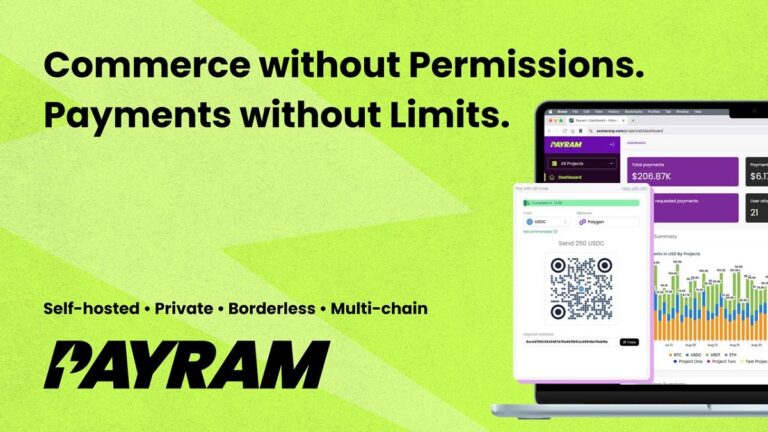
PayRam, a pioneering provider of self-hosted blockchain payment infrastructure, has announced support for the Polygon network, significantly expanding its multi-chain stablecoin payment capabilities.
The integration aims to enable global merchants to accept low-cost, censorship-resistant crypto payments while preserving full control of funds and data, a departure from traditional centralized payment systems.
PayRam’s expansion to Polygon follows its support for major networks including Ethereum, Base, Tron, and Bitcoin, with planned integrations for Solana and TON.
Merchant adoption of stablecoin payments has surged as businesses seek alternatives to conventional processors such as PayPal and Stripe, which critics say expose operators to settlement delays, account freezes, opaque policies and high cross-border fees.
The move positions PayRam as a key player in stablecoin payment infrastructure, a primary keyword that reflects growing interest in decentralized payment adoption among merchants and crypto-native enterprises alike.
This expansion could accelerate the broader adoption of stablecoins for commerce, particularly in regions where traditional payment rails are costly or unreliable.
Unlike conventional payment service providers (PSPs) and many existing crypto payment gateways, PayRam operates on merchant-controlled servers.
This self-hosted model enables businesses to maintain full self-custody of digital assets and eliminates dependence on third-party custodians that can freeze accounts or alter terms without notice.
At the core of PayRam’s design is a proprietary smart contract system that generates unlimited unique deposit addresses for customers.
This architecture streamlines reconciliation and accounting while preserving privacy and control. Crucially, no private keys or seed phrases are stored on merchant servers; instead, funds are swept automatically to merchant-controlled cold storage via secure smart contracts.
“This design ensures that PayRam is truly permissionless: it cannot be frozen, disabled, or altered by external authorities,” PayRam’s founders said in the announcement.
Such features appeal to merchants operating in highly regulated or high-risk sectors, including cross-border commerce, digital services and gaming.
Polygon, an Ethereum Layer-2 scaling solution, is optimized for high throughput and low transaction costs. Its inclusion in PayRam’s network suite is intended to enhance the cost efficiency and speed of stablecoin payments, particularly for high-volume merchants and micro-transactions.
Polygon’s ecosystem has been increasingly attractive for payment and decentralized finance use cases because it combines Ethereum compatibility with faster confirmation times and predictability.
This makes it suitable for merchants seeking to process large volumes of stablecoin transactions without the high gas costs often associated with Ethereum mainnet.
By integrating Polygon alongside Ethereum, Base, Tron and Bitcoin, PayRam is reinforcing its commitment to broad multi-chain interoperability and reduced friction in digital payments.
Since its launch, PayRam reports processing more than $100 million in on-chain volume and hundreds of thousands of transactions.
Merchants across Europe, Asia, Latin America and emerging markets are reportedly deploying the platform to mitigate challenges posed by centralized PSPs and to preserve operational autonomy.
Use cases include ecommerce platforms, SaaS companies, digital service providers, cross-border merchants, freelancers and contractor networks seeking stable, censorship-resistant settlement systems.
The platform’s ability to provide real-time settlement directly to merchant wallets helps streamline cash flows and removes intermediary delays.
A key differentiator for PayRam is its emphasis on privacy and data sovereignty.
Because the system is self-hosted, customer and transaction data remain within the merchant’s environment and are not pooled into a centralized database subject to monetization or oversight.
In an era of increasing data regulation and concerns over consumer privacy, this architecture appeals to merchants looking to bolster trust with their customers and reduce reliance on third-party data custodians.
The expansion of crypto payment solutions comes amid wider adoption of stablecoins and blockchain infrastructure for commerce.
Stablecoins such as USDT and USDC have been increasingly used for cross-border remittances, ecommerce and decentralized finance (DeFi) activities.
Integration with scalable blockchains like Polygon can reduce costs and increase accessibility for businesses of all sizes.
This trend is mirrored by other developments in the space, such as companies adopting Polygon’s network for stablecoin payments and cross-border products that leverage its low-fee architecture.
Do you have any story or press releases you want to share? Send tips to editor@envestreetfinancial.com
Follow us on Twitter, Facebook, or LinkedIn to ensure you don’t miss out on any