
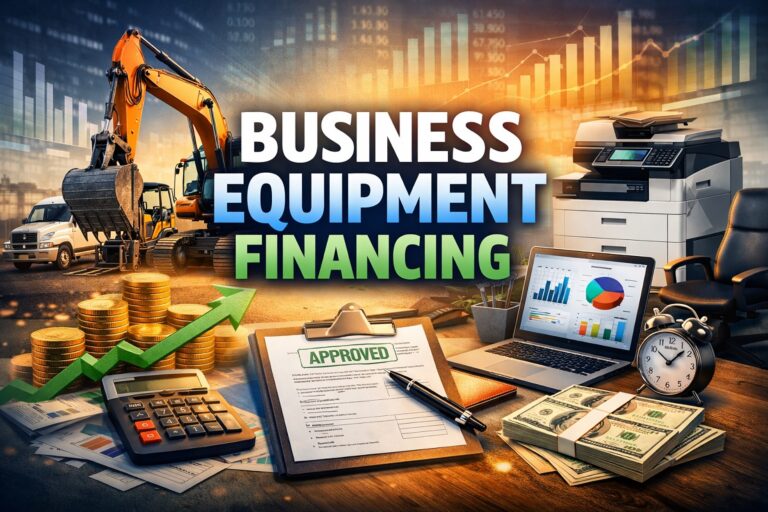
In an era marked by tighter cash flows and shifting economic landscapes, business equipment financing has emerged as a vital tool for companies seeking to acquire machinery, technology and essential assets without large upfront expenditure.
As firms globally balance growth with financial stability, this targeted form of financing is increasingly seen as both a growth enabler and a risk management strategy.
Business equipment financing refers to a range of credit solutions specifically designed to help companies purchase or lease tangible assets needed for operations, from heavy construction machinery and medical diagnostic tools to trucks and IT hardware.
Unlike general-purpose business loans, this form of finance is secured by the equipment itself, reducing dependence on broad credit lines and often making approval more attainable for smaller and mid-sized firms.
At its core, business equipment financing allows companies to spread the cost of an acquisition over an agreed period.
The process typically begins when a business identifies the specific equipment it needs and applies to a lender, which might be a bank, an online finance provider, or a specialized equipment lender, submitting relevant financial information and vendor quotations.
If approved, funds are often disbursed directly to the supplier, and repayments are made in fixed instalments over months or years.
This structure helps protect a company’s working capital and offers predictability in expense planning, crucial for firms operating with limited cash reserves or seasonal revenue patterns.
There are several variations of business equipment financing, each suited to different operational and fiscal needs:
Equipment Loans: Traditional financing whereby the borrower owns the asset during and after repayment. The equipment serves as collateral, often improving credit prospects due to reduced risk for lenders.
Equipment Leasing: The lender retains ownership of the equipment while the business pays for its use. Leasing can be attractive for technology and equipment that quickly becomes outdated, though ownership does not transfer without a buy-out.
Alternative Financing Agreements: Some lenders offer tailored structures where ownership and payment conditions differ, such as sale-leasebacks or flexible term arrangements. These can suit firms seeking fast approvals and flexible terms without traditional bank requirements.
Each structure has trade-offs; loans often lead to ownership and longer-term cost savings, while leases may offer lower upfront payments and flexibility.
The appeal of business equipment financing spans industries and company sizes. Construction firms use it to invest in heavy machinery, healthcare providers to acquire diagnostic equipment, and logistics companies to upgrade fleets, all without immobilizing capital.
Key benefits include:
Cash Flow Management: By converting large capital costs into predictable payments, firms can align expenses with revenue generation cycles, easing financial planning.
Access to Latest Technology: Financing enables companies to acquire up-to-date equipment that enhances productivity and competitiveness, particularly in fast-evolving sectors.
Tax Advantages: Interest payments and asset depreciation can sometimes be tax-deductible, reducing overall financial burden.
Preservation of Credit Lines: By undertaking dedicated financing for equipment needs businesses can keep broader credit facilities available for other strategic uses.
While financing equipment presents clear advantages, it also entails risks. Because the equipment itself serves as collateral, failure to meet repayment terms can lead to repossession, which can severely disrupt operations if the equipment is mission critical.
Interest rates and terms vary widely depending on a company’s credit profile, the age and type of equipment, and prevailing economic conditions.
Well-established businesses with strong credit can secure favorable rates, while newer or higher risk firms may face higher costs.
Recent data suggests evolving trends in equipment financing activity.
In the United States, US business equipment borrowings grew by nearly 5.9% year-on-year in December 2025, with new loans, leases and lines of credit reaching $10.6bn, the second-highest level on record.
Despite a slight monthly decline in bank lending, industry confidence remains high, with expectations for continued demand support if interest rates move lower.
However, some periods saw reduced borrowing, for example in November 2025, equipment financing was down by more than 4% compared with the prior year, reflecting short-term shifts in economic conditions and investment strategies.
Internationally, governments and development agencies are also facilitating access to equipment financing for small and medium enterprises (SMEs).
Credit guarantee schemes in countries like India aim to reduce collateral barriers and enable manufacturing firms to secure machinery vital for growth and employment.
As global markets navigate sluggish growth and tightening financial conditions, business equipment financing remains central to corporate investment strategies.
It enables companies to modernize operations, maintain competitiveness and preserve liquidity.
Do you have any story or press releases you want to share? Send tips to editor@envestreetfinancial.com
Follow us on Twitter, Facebook, or LinkedIn to ensure you don’t miss out on any