
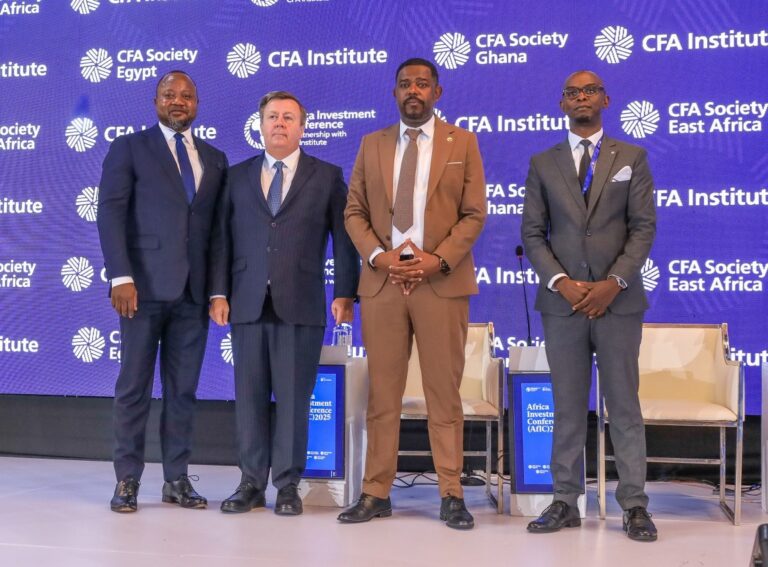
Top finance leaders and policymakers from across the African continent have called for strengthened intra-Africa investment frameworks to unlock capital and fuel sustainable economic growth, during the opening of the Africa Investment Conference (AfIC) 2025 in Nairobi.
Hosted by CFA Society East Africa under the theme “Africa Investing in Africa: Solutions to Challenges,” the gathering brought together investors, public officials, financial professionals and private-sector executives to confront structural barriers hindering investment flows within the continent.
Addressing delegates, Abubakar Hassan Abubakar, Principal Secretary at Kenya’s State Department for Investment Promotion, said the continent must deepen financial integration and unlock domestic capital to compete globally.
“Africa is at a turning point and for us to compete globally, we must unlock capital within our borders, accelerate the growth of both our private and public capital markets, and build deeper financial market linkages,” he asserted, underscoring the critical role of intra-Africa investment frameworks in shaping the continent’s economic future.
Delegates highlighted that Africa’s demographic expansion, burgeoning urban populations and soaring demand for infrastructure and technology investment require home-grown capital solutions rather than reliance on external funding.
Abubakar emphasized the importance of streamlining investment regulations and establishing predictable market environments that can attract long-term capital, especially for projects with developmental impact.
“The Government of Kenya is committed to enhancing the country’s position as a gateway for investment into East Africa and across the continent,” Abubakar added, citing efforts to improve the ease of doing business and strengthen investor protection as cornerstones of this strategy.
Francis Nasyomba, President of CFA Society East Africa, described the conference as a catalyst for progress by bringing together policymakers, capital providers and market practitioners to forge actionable pathways that support stronger financial markets and better-aligned investment flows.
A central focus of the forum was dismantling persistent obstacles to cross-border capital movement that have long stifled intra-African investment.
Despite the ambitious framework of the African Continental Free Trade Area (AfCFTA), which is designed to create a unified continental market, regulatory bottlenecks, fragmented capital markets and limited financial integration continue to inhibit investment across borders.
Experts emphasized that resolving these issues is essential to reversing Africa’s investment slump and boosting economic resilience. Recent analysis suggests that Africa’s financial systems lose an estimated 4 per cent of GDP annually owing to regulatory impediments and restrictive policies that dampen the movement of capital.
Addressing these structural constraints will also require projects that meet bankability standards, attractive to investors in risk-adjusted returns and supported by robust governance frameworks.
As one market leader noted, developing bankable investment opportunities is critical to tapping Africa’s abundant financial assets, which are concentrated in public and private financial instruments rather than transformative infrastructure or industrial projects.
The conference delegates also spotlighted the need to deploy African-designed investment models tailored to the continent’s unique realities.
Infrastructure and innovation were identified as strategic priorities: scaling digital connectivity, transport networks and energy systems that can underpin intra-Africa trade and economic diversification.
Research indicates that Africa faces an annual infrastructure financing gap in the range of $130 billion to $170 billion, with only about $80 billion currently invested each year.
Addressing this shortfall demands aligned efforts from governments, private sector firms, development partners and multilateral institutions to ensure sustainable and impactful project outcomes.
Strengthening intra-Africa investment frameworks is inseparable from deeper regional market integration. A lack of seamless capital mobility and weak strategic alliances among African financial markets have historically limited liquidity and investor confidence.
Conference participants stressed that fostering cooperation among stock exchanges, regulatory bodies and investment vehicles is essential to building a more unified financial ecosystem.
Across the continent, initiatives such as the Pan-African Payments and Settlement System (PAPSS) and programs aimed at empowering African entrepreneurs with scalable technology solutions are already contributing to progress, though further scaling and policy support remain necessary.
Delegates at AfIC 2025 framed the need for stronger investment frameworks within the broader context of AfCFTA implementation.
Data from related continental trade forums shows intra-African trade rebounding and diversifying beyond traditional commodities into machinery, vehicles and manufactured goods, marking a shift towards industrialization that must be anchored by robust financial infrastructure.
In this evolving landscape, the call for stronger intra-Africa investment frameworks resonates as both an economic imperative and a strategic priority for sustaining long-term growth, competitiveness and shared prosperity across Africa.
Do you have any story or press releases you want to share? Send tips to editor@envestreetfinancial.com
Follow us on Twitter, Facebook, or LinkedIn to ensure you don’t miss out on any