
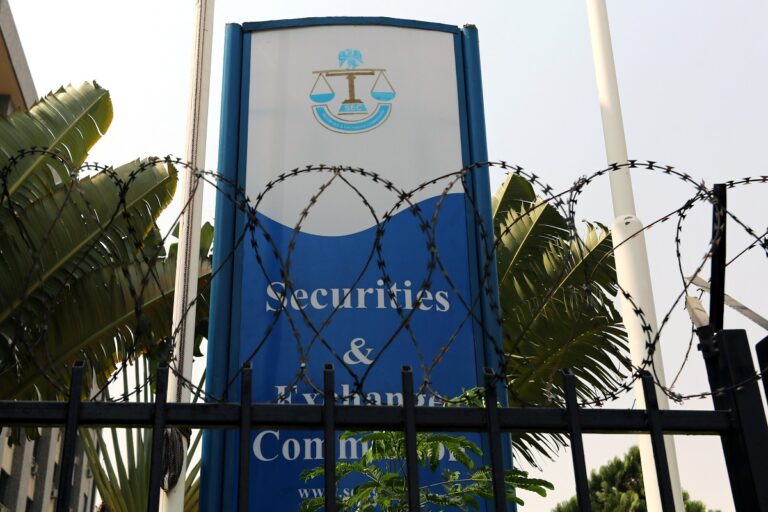
Nigeria’s Securities and Exchange Commission (SEC) has announced a sweeping overhaul of minimum capital requirements for regulated capital market entities, marking the most significant reform of the country’s capital adequacy framework in more than a decade.
In a circular dated 16 January 2026, the Commission said the revised thresholds are intended to strengthen market resilience, enhance investor protection and align capital requirements with the growing complexity of Nigeria’s financial markets.
The new rules apply across a broad range of market participants, including brokers, fund managers, exchanges, fintech firms, virtual asset service providers and commodity market intermediaries.
All affected entities must comply by 30 June 2027, after which non-compliant firms risk sanctions, suspension or withdrawal of registration.
According to the SEC, the decision reflects the evolving risk profile of Nigeria’s capital markets, particularly as new products such as digital assets, commodities trading and alternative investment funds gain prominence.
The regulator said the revised framework aims to ensure that licensed operators have “sufficient financial capacity to discharge their obligations in a sustainable manner,” while also supporting innovation and orderly market development.
Nigeria last reviewed minimum capital requirements in 2015. Since then, the market has expanded significantly in scale and sophistication, prompting concerns that outdated capital thresholds may no longer offer adequate protection against operational failures or systemic shocks.
Under the new regime, capital requirements for core brokerage activities have risen sharply.
A broker offering client execution services will now be required to hold ₦600m, up from ₦200m, while a dealer engaged in proprietary trading must meet a minimum of ₦1bn, compared with ₦100m previously.
Firms combining brokerage, dealing, margin lending and advisory services face a new minimum capital threshold of ₦2bn, more than six times the earlier requirement.
The SEC also raised requirements for sub-brokers, with digital sub-brokers now required to hold ₦100m, compared with ₦10m under the previous framework.
Fund and portfolio management firms are among the most affected by the reforms.
Tier-one portfolio managers, handling assets above ₦20bn and permitted exposure to foreign instruments of up to 40%, must now hold ₦5bn in capital, up from ₦150m. Firms managing more than ₦100bn in assets are required to maintain capital equivalent to at least 10% of assets under management.
Tier-two managers with limited scope operations will be required to hold ₦2bn, while private equity and venture capital fund managers must meet new minimums of ₦500m and ₦200m, respectively.
Market infrastructure institutions have also seen substantial increases.
A composite securities exchange, which trades and lists multiple classes of securities, must now maintain ₦10bn in capital, double the previous threshold. Clearing and settlement companies face a new requirement of ₦5bn, compared with ₦200m previously.
The SEC said the higher thresholds reflect the systemic importance of these institutions and their role in maintaining market integrity and stability.
For the first time, the SEC has set detailed capital requirements for virtual asset service providers, reinforcing its intent to bring Nigeria’s fast-growing digital asset sector firmly within a regulated framework.
Digital asset exchanges and custodians must each hold ₦2bn, while platforms involved in real-world asset tokenization are required to maintain ₦1bn in capital. Ancillary virtual asset service providers must meet a ₦300m threshold.
Fintech operators such as robo-advisers and crowdfunding intermediaries are also affected, with minimum capital requirements raised to ₦100m and ₦200m, respectively.
Commodity market intermediaries, including brokers, dealers and warehousing operators, face increases ranging from ₦20m to ₦500m, depending on the scale of operations.
Capital market consultants, often the smallest participants in the ecosystem, are not exempt. Corporate consultants must now hold ₦25m, while individual consultants are required to meet a ₦2m threshold.
The SEC has allowed an 18-month transition period to enable firms to raise additional capital or restructure their operations. The Commission said it may consider transitional arrangements on a case-by-case basis, with further guidance on compliance to be issued separately.
Do you have any story or press releases you want to share? Send tips to editor@envestreetfinancial.com
Follow us on Twitter, Facebook, or LinkedIn to ensure you don’t miss out on any