
Norway has reaffirmed its long-standing commitment to Africa’s development with a NOK 3.1 billion pledge to the African Development Bank Group’s concessional window, the African Development Fund (ADF), under its seventeenth replenishment cycle.
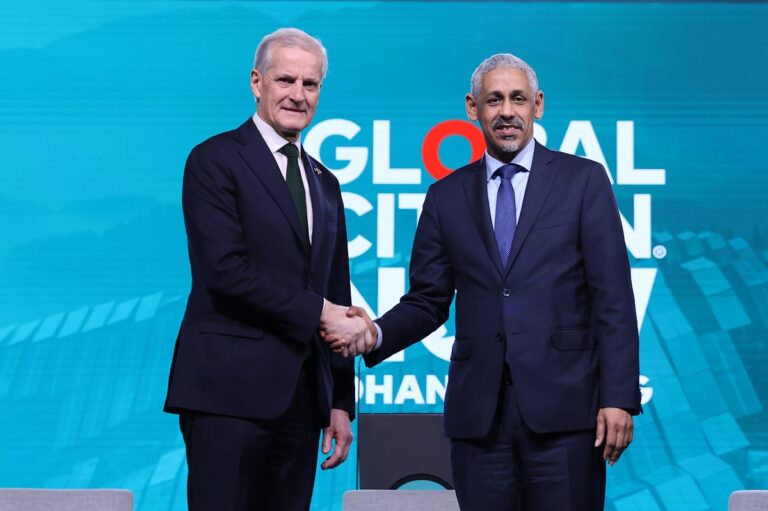
The announcement was made during the Global Citizen Now: Johannesburg event held on 21 November and later reinforced in a bilateral meeting between Norwegian Prime Minister Jonas Gahr Støre and the AfDB President Sidi Ould Tah.
The commitment comprises a core contribution of NOK 2,377 million, a 5.79 per cent increase compared with the previous replenishment round (ADF-16), alongside NOK 150 million pledged specifically for the Fund’s Climate Action Window. Earlier in 2025, Norway already became the fifth donor to that window with a NOK 50 million contribution.
In a joint statement welcoming the pledge, Mr Støre said all nations share a responsibility “to build a more peaceful and equitable world”. He added that the funds, earmarked for improving access to food, electricity, water and sanitation, health services, education, and job creation, would “improve the lives of some of the world’s poorest people.”
Mr Sidi Ould Tah, on his part, described Norway as “a highly valued partner” and said the renewed commitment underscores shared goals such as youth opportunity, sustainable growth, and strong partnerships. He emphasised that the support comes at “a decisive moment for Africa’s most vulnerable economies.”
Norway has participated in every replenishment cycle of the ADF since joining in 1973, illustrating decades of consistent engagement in Africa’s development.
The African Development Fund is the concessional financing arm of the AfDB, supporting 37 low-income African countries. Since its inception in 1972 (operational from 1974), the ADF has provided grants, highly concessional loans, and guarantees to underpin investments in sectors such as energy, transport, agriculture, water and sanitation, governance, and regional integration.
Donor funding, renewed every three years through replenishment cycles, underwrites long-term development programmes and helps sustain essential services for vulnerable populations. The upcoming seventeenth replenishment (ADF-17) will be tabled for final pledges at a session scheduled in London from 15 to 16 December 2025.
In previous cycles, ADF has channelled funds into massive infrastructure, social services and climate-resilience projects. For instance, the sixteenth replenishment, concluded in 2022, mobilised US $8.9 billion, the largest in the Fund’s 50-year history, supporting sustainable infrastructure, transport, energy, agriculture, and sanitation across the continent.
Norway’s increased pledge now positions ADF to continue and possibly expand similar interventions, with particular emphasis on delivering reliable services; electricity, water, health, education in poor and climate-vulnerable regions. This is especially critical as many low-income African countries navigate overlapping challenges: food insecurity, lack of infrastructure, and climate change.
The timing of the pledge, ahead of the ADF-17 final pledging session, sends a strong signal to other donor nations of Norway’s commitment. It also reinforces Norway’s 2024 Africa engagement strategy, reflecting long-term ambition beyond one-off donations.
Moreover, directing a portion to the Climate Action Window highlights the union of development and climate resilience: key given Africa’s rapidly rising vulnerability to climate change, and the need for resilient infrastructure, water systems, and disaster-resilient social services.
The support aligns with continental ambitions such as Mission 300, an ADF-backed effort aimed at expanding electricity access across Africa to 300 million people by 2030.
The ADF-17 pledging session in London (15–16 December 2025) will be the decisive moment when all development partners finalize their contributions. Norway’s early commitment may spur further pledges from other countries, strengthening the Fund’s capacity to support Africa’s poorest nations.
As the continent continues to grapple with infrastructure deficits, climate shocks, and socio-economic fragility, dependable financing from multilateral funds like the ADF remains crucial. For many African countries, the success of ADF-17 could shape development trajectories over the next three years.
Do you have any story or press releases you want to share? Send tips to editor@envestreetfinancial.com
Follow us on Twitter, Facebook, or LinkedIn to ensure you don’t miss out on any