
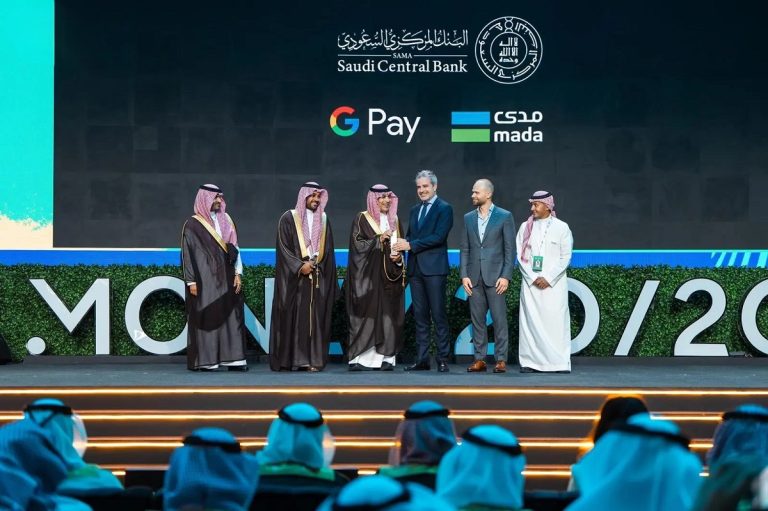
The Saudi Central Bank (SAMA) has announced the official launch of Google Pay in Saudi Arabia through the national payment system, mada. It has also signed an agreement with Ant International to enable Alipay+ payments across the Kingdom by 2026.
The announcement was made at the Money20/20 Middle East conference in Riyadh, attended by regional fintech stakeholders and government leaders, laying out steps to further modernise Saudi Arabia’s payments infrastructure.
Google Pay will allow users to securely add and manage mada debit cards, as well as digital credit cards (Visa and Mastercard), through the Google Wallet application. Initially, “Tap to Pay” functionality will be available for in-store purchases, with support for in-apps and web payments to follow. Security features include industry standard tokenisation; each transaction replaces a card number with a virtual token tied to the user’s device.
The service launch will begin with Al Rajhi Bank and Riyad Bank, with other banks expected to be onboarded over time.
As part of its efforts to serve international visitors and integrate global digital wallets, SAMA’s agreement with Ant International will enable acceptance of Alipay+ at Saudi retail outlets through mada by 2026. This move is intended to facilitate cross-border digital payments.
These developments align closely with Saudi Arabia’s Vision 2030 objectives, particularly its Financial Sector Development Program, which aims to enhance financial inclusion, foster innovation, and reduce dependence on cash transactions.
Some Google Pay and Google Wallet features are only available in specific countries, regions, or on certain devices. Once a payment method is set up, you can use Google Pay for both online and in-store purchases.
In stores, you can simply tap your device to make a contactless payment, just as you would with a contactless card. When shopping online, selecting the Google Pay option at checkout will automatically populate your payment and shipping details, eliminating the need to enter them manually each time.
SAMA Governor Ayman Al-Sayari cited substantial growth in the Kingdom’s fintech sector: from 82 fintech firms at end-2022 to around 281 by August 2025. Total investments in the fintech sector have reached SR 9 billion (roughly US$2.39 billion).
Also, electronic payments accounted for about 79% of Saudi Arabia’s retail payments in 2024. The number of electronic transactions processed rose to 12.6 billion in 2024 from 10.8 billion in 2023.
The Google Pay rollout augments consumer convenience, boosts digital payments security, and supports financial inclusion, especially for younger, tech-savvy populations. It may also help Saudi Arabia better accommodate international tourists, expatriates and business visitors who already use wallet-based payment systems abroad. Alipay+ acceptance by 2026 is particularly aimed at visitors from Asia and other regions.
There are two main technologies that underpin a Google Pay transaction, working together to ensure speed and security.
First, the process relies on contactless payment technology, activated when an Android device is held close to a compatible point-of-sale terminal. This interaction triggers Near Field Communication (NFC) – a short-range wireless protocol that uses radio waves to establish a secure connection between the customer’s digital wallet and the merchant’s payment system.
Once the connection is made, Google Pay does not transmit the customer’s actual card number. Instead, it uses tokenisation – replacing sensitive card details with a unique, encrypted virtual account number. This means the merchant never sees the customer’s real financial information, significantly reducing the risk of fraud.
Although the underlying technology is sophisticated, the user experience is simple: the entire transaction is completed in just a few seconds with a single tap.
Do you have any story or press releases you want to share? Send tips to editor@envestreetfinancial.com
Follow us on Twitter, Facebook, or LinkedIn to ensure you don’t miss out on any