
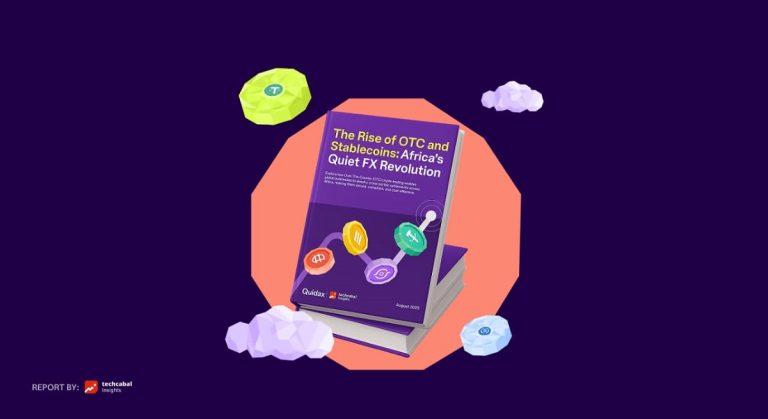
Africa’s foreign exchange landscape is undergoing a radical transformation, driven not by high-street financiers, but by the quiet rise of digital currencies. A new report, The Rise of OTC and Stablecoins: Africa’s Quiet FX Revolution, produced by TechCabal Insights in collaboration with Quidax Technologies, reveals stablecoins and over-the-counter (OTC) crypto trading are rapidly reshaping cross-border financial flows across Sub-Saharan Africa.
Quidax is an African-founded cryptocurrency exchange (www.Quidax.io) that makes it easy for anyone to buy, sell, store and transfer cryptocurrencies. Quidax additionally enables OTC trading (https://apo-opa.co/3JaIGro) and gives fintechs the tools to offer cryptocurrency services to customers through a dedicated crypto API. Quidax was officially launched in 2018 and has customers in over 70 countries.
According to the report, stablecoins now account for a remarkable 43% of all cryptocurrency transactions in Sub-Saharan Africa, a dramatic leap from previous years. Meanwhile, global OTC crypto volumes surged by 106% year-on-year in 2024, much of which was driven by stablecoin transactions tailored to African markets.
Nigeria, Africa’s largest economy, is now second globally behind only India in crypto transaction volume, processing more than $59 billion in 2024. Countries like Ethiopia and Zambia also saw more than 100% year-on-year growth in stablecoin inflows, underscoring the continent-wide momentum.
The shift to stablecoins and OTC trading is not speculative; it is driven by urgent, practical needs: Foreign exchange shortages across many African economies limit access to US dollars, forcing businesses and individuals to explore alternative settlement methods.
Businesses across Africa are increasingly turning to OTC desks (https://apo-opa.co/3JaIGro) and stablecoins to streamline cross-border payments, manage FX volatility, and access faster, more compliant settlement solutions. Far from being late to the party, the report available here (https://apo-opa.co/4mwqGWE) positions Africa as a pivotal frontier in the global digital finance revolution.
OTC trading platforms offer discreet, peer-to-peer settlement often brokered via WhatsApp or Telegram that sidestep liquidity constraints and exchange limitations.
Through stablecoin-denominated transfers, users can mitigate FX volatility, pay suppliers, send remittances, and receive international payments faster and more cost-effectively.
This digital FX infrastructure is not aspirational it is already used by freelancers, small and medium-sized enterprises (SMEs), exporters, and pan-African digital service providers.
The report and supporting data highlight several advantages over traditional banking methods, with transactions settling almost instantly compared to the days-long processing times of conventional bank transfers.
By bypassing costly correspondent banking networks, they also reduce remittance and business payment expenses by as much as 60%, making cross-border transactions faster, cheaper, and more efficient.
African fintech innovators such as Quidax, Yellow Card, Busha, Treasura, Afriex, and others are actively building the tools and rails, including stablecoin wallets, OTC desks, and on-off ramps, to support this digital-led transformation of FX.
Governments across the continent are walking a thin line embracing innovation while safeguarding financial integrity. In Nigeria, the Central Bank has intermittently restricted crypto access, yet the sector persists through peer-to-peer OTC mechanisms.
Kenya and South Africa are exploring frameworks to regulate virtual asset service providers (VASP), attempting to establish oversight without stifling promise. South Africa, in particular, has made strides by declaring crypto assets as financial instruments, bringing them under a regulatory ambit.
As Africa moves deeper into digital payments, stablecoins and OTC trading may become the linchpins of cross-border commerce. Their rapid adoption is not hype it is adaptation to economic realities: FX scarcity, volatile currencies, and inadequate bank infrastructure.
If this momentum continues, Africa could lead a new model of currency flexibility and digital financial inclusion, delivering faster, cheaper, and more transparent FX services across the continent.
Do you have any story or press releases you want to share? Send tips to editor@envestreetfinancial.com
Follow us on Twitter, Facebook, or LinkedIn to ensure you don’t miss out on any