
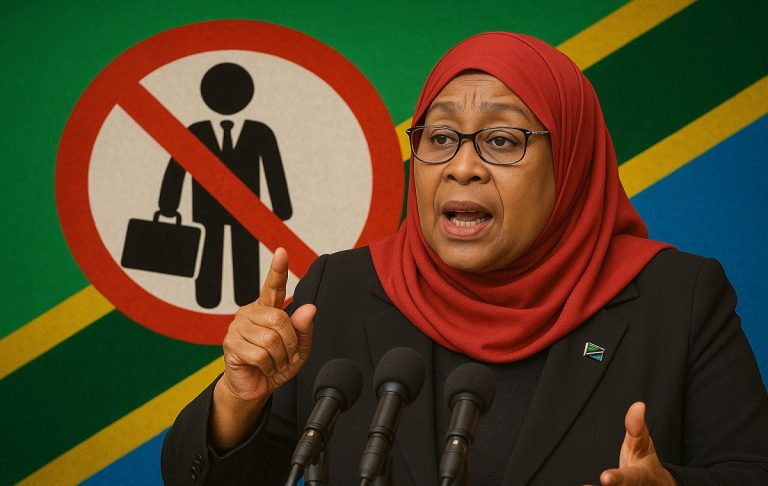
The Tanzanian government has issued a sweeping new order banning non-citizens from operating in 15 business sectors, a move that signals a significant shift in the country’s regulatory environment for foreign investors.
The new directive, titled The Business Licensing (Prohibition of Business Activities for Non-Citizens) Order, 2025, was published in the Government Notice No. 487A on July 28, 2025, and signed by the Minister for Industry and Trade, Selemani Saidi Jafo.
Effective immediately, the order prohibits non-citizens from obtaining or renewing licenses to operate businesses in a wide range of sectors including mobile money transfers, small-scale mining, salons, retail trade, and media.
The move is seen as part of the government’s broader push to empower local entrepreneurs and ensure that small and medium-sized business opportunities remain accessible to Tanzanians.
According to the order, any non-citizen currently holding a valid license in one of the restricted sectors may continue operations until the license expires. However, they will not be allowed to renew or reapply for a license in those sectors.
Under section 3(2) of the order, licensing authorities have been instructed not to issue or renew licenses for non-citizens engaged in the listed activities. The penalties for non-compliance are severe, including fines of not less than 10 million Tanzanian shillings or imprisonment of up to six months. Tanzanian citizens who aid foreigners in circumventing the law face similar penalties, with fines up to 5 million shillings.
The 15 business activities now off-limits to foreigners include:
| 1 |
Wholesale and retail sale of goods (excluding supermarkets and specialized outlets for local producers). |
| 2 |
Mobile money transfers. |
| 3 |
Repair of mobile phones and electronic devices. |
| 4 |
Salons, unless located in hotels or tourism facilities. |
| 5 |
Home-office and environmental cleaning services. |
| 6 |
Small-scale mining. |
| 7 |
Postal activities and local parcel delivery. |
| 8 |
Local tour guiding services. |
| 9 |
Operation of radio and television. |
| 10 |
Running museums or curio shops. |
| 11 |
Brokerage in business or real estate. |
| 12 |
Clearing and forwarding. |
| 13 |
On-farm crop purchasing operations. |
| 14 |
Ownership of gambling machines or devices, except in casinos. |
| 15 |
Ownership and operation of micro and small industries. |
With a population of about 69 million consumers, a rapidly growing economy, and high levels of domestic investment spending the Tanzania market will remain an important target destination for local and foreign products and services.
Tanzania is a lower-middle income country with a per capita GDP of $1,149. The economy is relatively diversified: agriculture accounts for about a quarter of total value addition, industry for a third, and services for the remainder.
While the policy is designed to bolster local ownership, some investors and analysts warn the move could discourage foreign investment and undermine efforts to position Tanzania as a business-friendly destination in East Africa.
“This directive may protect local traders in the short term, but it sends a concerning message to international investors who value predictability and open markets,” said one regional economist based in Nairobi.
However, government officials maintain that the sectors outlined in the order are already saturated or reserved for citizens under existing policies and that the new order banning non-citizens business merely reinforces those priorities with legal backing.
The new order does not impact sectors such as manufacturing, agriculture on a large scale, tourism, energy, or financial services areas where Tanzania continues to actively seek foreign direct investment.
Tanzania’s main trading partners are the EU, China, India and neighbouring Southern African Development Community (SADC) and East African Community (EAC) Countries. Exports to the USA are dominated by agricultural commodities, minerals and textiles while imports from the USA include wheat, agricultural/transport equipment, chemicals, used clothes and machinery.
Do you have any story or press releases you want to share? Send tips to editor@envestreetfinancial.com
Follow us on Twitter, Facebook, or LinkedIn to ensure you don’t miss out on any