
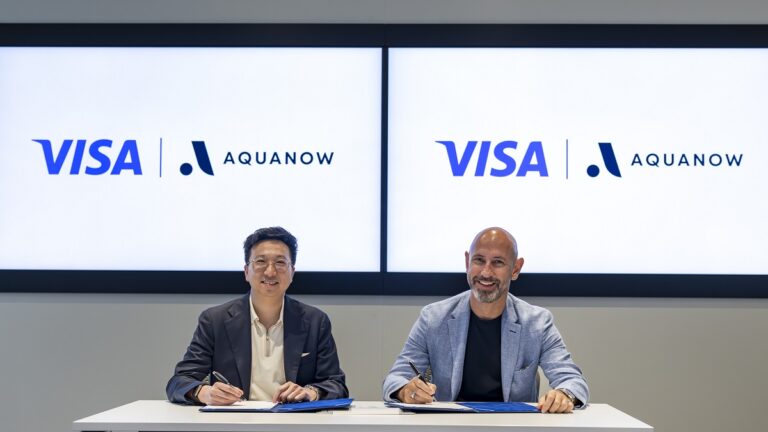
Global payments giant Visa has struck a major partnership with digital-assets infrastructure firm Aquanow to expand its stablecoin settlement capabilities across Central and Eastern Europe, Middle East and Africa (CEMEA) region, a move that could reshape cross-border money flows.
Under the deal, Visa’s network of issuers and acquirers will now be able to settle transactions using approved stablecoins such as USDC. The integration of Aquanow’s digital-asset infrastructure with Visa’s global payments platform is designed to reduce costs, cut operational friction and shorten settlement times, even on weekends and holidays.
According to Visa, the stablecoin settlement system will support 365-day settlement, effectively enabling real-time or near-instant payment finality any day of year.
Visa first piloted stablecoin-based settlement in 2023, when it began allowing select clients to settle obligations in USDC. Since then, the monthly volume of stablecoin settlement processed by Visa has accelerated, reaching a multi-billion-dollar annualized run-rate.
Visa became one of the first major payments networks to settle transactions in stablecoin when it piloted enabling clients to fulfill their settlement obligations in USDC. To date, monthly volume has passed a $2.5 billion annualized run rate.
The Aquanow partnership marks a deliberate effort by Visa to modernize the “back-end rails” of payments, reducing dependence on traditional banking intermediaries and legacy cross-border payment systems.
As Godfrey Sullivan, Visa’s Head of Product and Solutions for CEMEA, noted: “By harnessing the power of stablecoins and pairing them with our trusted global technology, we are enabling financial institutions in CEMEA to experience faster and simpler settlements.”
Echoing that sentiment, Aquanow CEO Phil Sham said the collaboration “unlocks new ways for institutions to participate in the digital economy, leveraging stablecoin technology to settle with the speed and transparency of the internet.”
Aquanow is a global institutional digital asset platform with deep expertise in liquidity and infrastructure, powering fast-growing banks, neobanks, brokerages, and payment companies. The company operates technology infrastructure and underwrites billions of dollars in monthly crypto brokerage and payment transactions. Established in 2018, Aquanow employs over 170 team members across offices worldwide.
For many financial institutions across Africa and other emerging markets, cross-border payments remain costly, slow and dependent on multiple intermediaries, with delays especially during weekends or around banking holidays.
The adoption of stablecoin settlement offers a compelling alternative. With on-chain settlement, funds can move quickly across borders, liquidity can be managed more tightly, and financial institutions can reduce exposure to local currency volatility.
In a region where access to reliable banking and predictable liquidity often faces systemic limitations, this development has the potential to significantly boost efficiency, particularly for banks, remittance providers, fintechs, and corporate treasury operations.
Moreover, the move may accelerate the adoption of digital-dollar denominated systems. Stablecoins such as USDC, which are pegged to the U.S. dollar offer a dollar-denominated alternative to local currencies that are sometimes prone to devaluation.
For businesses and institutions operating across multiple African jurisdictions, stablecoin settlement could enable greater consistency in cross-border trade and payments.
This latest partnership builds on Visa’s broader stablecoin strategy launched in 2025. Earlier this year, the company expanded its stablecoin settlement platform to support additional USD-backed stablecoins and new blockchain networks, including euro-backed stablecoins and multiple blockchains beyond Ethereum.
In parallel, Visa has rolled out stablecoin-linked products aimed at creators, gig workers, fintechs and other businesses, allowing payouts directly to stablecoin wallets, improving speed and flexibility of global payments.
While stablecoin settlement offers speed and efficiency, it is not without risks. As noted in Visa’s press release, virtual assets remain subject to price fluctuation and currently lack the same deposit protections that traditional banking systems offer.
Moreover, regulatory scrutiny across different African jurisdictions and the broader CEMEA region could affect uptake. Regulatory frameworks for digital assets vary widely across countries, which may slow adoption among some banks or institutions.
Nonetheless, for institutions ready to embrace blockchain-based settlement, the Visa-Aquanow partnership could signal a turning point, one where stablecoins begin to operate side-by-side with traditional payment rails in Africa.
Do you have any story or press releases you want to share? Send tips to editor@envestreetfinancial.com
Follow us on Twitter, Facebook, or LinkedIn to ensure you don’t miss out on any